Carbon fiber components serve different purposes in medical and precision equipment. A support beam carries weight across a span. A sensor plate holds an instrument in position. An enclosure may need a clean finish and a shape that fits the surrounding equipment.
Dimensions and weight are useful starting points, but they do not define the complete requirement. Carbon fiber material selection also needs to account for loads, mounting accuracy, cleaning conditions and the cost of the finished part.
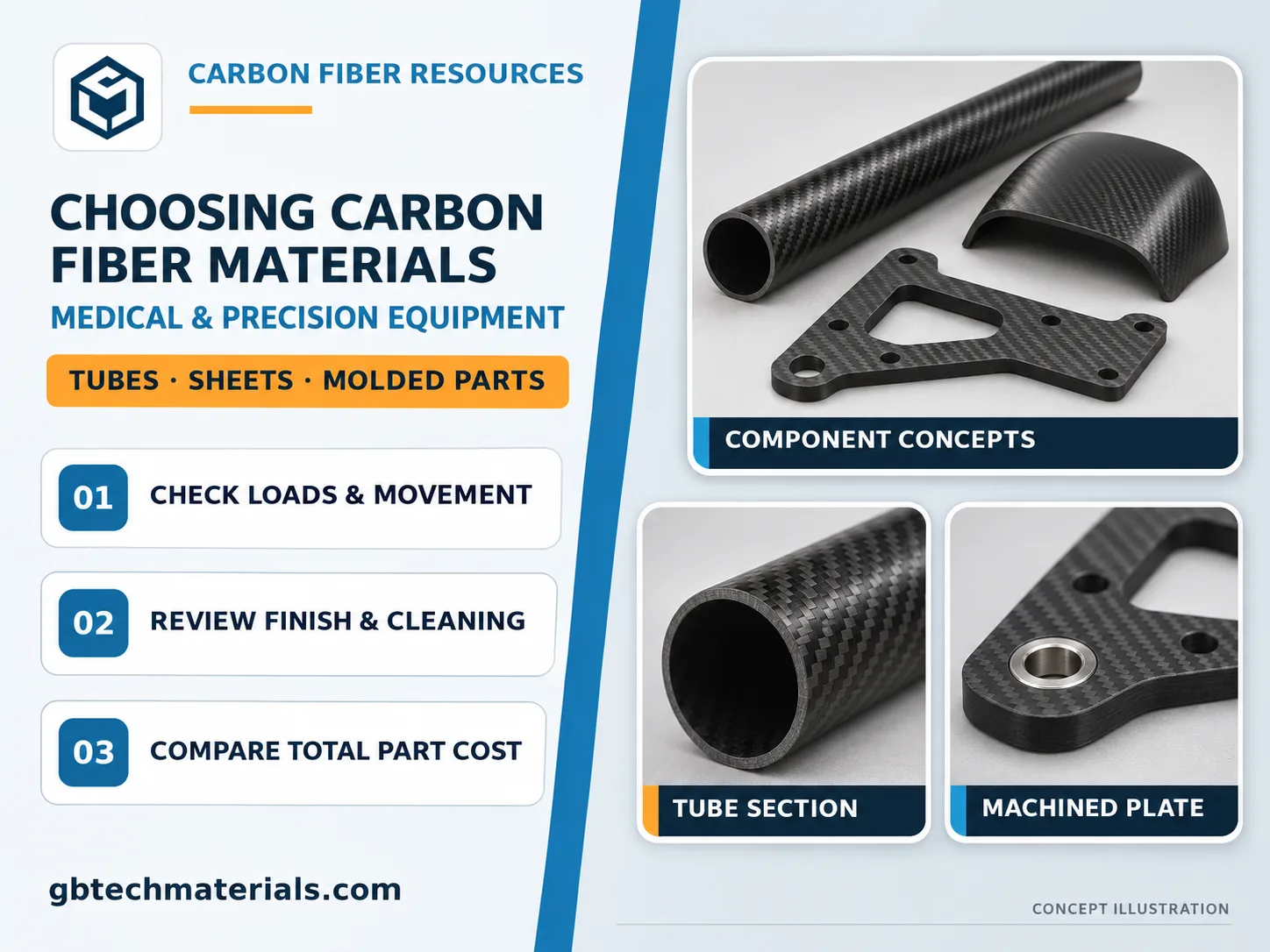
A long support member needs sufficient stiffness for its span and load. A small sensor bracket may depend more on hole position and the stability of its mounting face. Similar dimensions do not necessarily mean similar material requirements.
An enquiry should explain what the component carries, how it is fixed and whether it moves during operation. Identify any position or dimension that must remain within a specified limit.
When replacing a metal part, describe the intended improvement. Reducing moving mass, simplifying handling and limiting deflection can lead to different design decisions. This information helps the supplier review the material and connections before manufacturing begins.
For beams, support rods and frames, carbon fiber tubes are often worth evaluating first. Standard round or square sections may be suitable when their dimensions, construction and connection options meet the application requirements. Cutting, drilling and appropriate fittings can complete the component.
Flat mounting plates, sensor brackets and relatively simple profiles may suit machining from carbon fiber sheets. Thickness, fiber arrangement and cutout positions should be reviewed against the finished geometry and loading.
Continuous curves, complex corners or integrated features may justify a molded part. Tooling costs, sample adjustments and expected order quantities should be included in the comparison.
Custom CFRP components do not always require a new mold. Some can be machined from suitable standard stock, while particular loading requirements may call for a custom laminate.
A component can carry its load without breaking yet still deflect too much for the equipment. This distinction matters for camera supports, measurement frames and locating plates, where small movements can affect alignment.
Specify acceptable deflection and identify the dimensions that influence equipment performance. Tube wall thickness, laminate construction and connection details should be assessed against those requirements.
Temperature and humidity also affect carbon fiber material selection. Low thermal expansion along a fiber direction does not describe the behavior of the complete assembly. Resin, metal fittings and mounting constraints contribute to dimensional changes.
Where stability is critical, agree on prototype checks using representative supports, loads and environmental conditions. These checks provide a more useful basis for acceptance than appearance or material grade alone.
Surface pattern, gloss and color can be selected to suit the equipment’s appearance. Compatibility with cleaning processes requires a separate review.
For medical composite materials, provide the proposed cleaning agents, exposure time, temperature and frequency. State whether the component will undergo wiping, disinfection or a sterilization process.
The resin, coating, adhesive and attached materials should be assessed for those conditions. Cut edges, holes and assembly gaps also deserve attention because the entire component must suit the intended process.
A smooth surface does not establish cleaning effectiveness or compatibility with repeated treatment. Where patient contact is involved, the device manufacturer should define the contact conditions and arrange the relevant evaluation and validation. Suitability cannot be established from the material name alone.
Stock price represents only part of the purchase cost. Material waste, drilling, mounting-face machining, fittings, surface treatment and inspection can change the total substantially.
For small quantities of simple components, machining standard tube or sheet stock may be practical. For recurring orders or complex shapes, a molded design may deserve comparison if it can reduce later machining and assembly.
Use the same drawing and delivery requirements when requesting quotations. A blank plate, a machined bracket and an assembled component represent different supply scopes.
A consistent comparison makes carbon fiber material selection more reliable. It also helps identify whether a price difference comes from the material, manufacturing steps, inspection requirements or included hardware.
A useful drawing package includes dimensions, quantities, supported loads, mounting details, critical tolerances and the operating environment. Add cleaning requirements where relevant. Photos of an existing component can clarify space limits and assembly access.
For precision equipment composites, mark the features that directly affect alignment or measurement and explain how they will be inspected.
GBTECH can review tube and sheet options, CNC machining and custom manufacturing from this information. Providing the drawings together with the intended working conditions helps identify suitable standard materials, requirements needing customization and the sample checks to complete before production.
GBTECH U.S. Sales & Support
Website: www.gbtechmaterials.com
Email: zane@gbtechgroup.cn
Phone: +1 (510) 902-9987
California Warehouse: 38758 Buckboard Common, Fremont, CA 94536, United States
China Manufacturing Headquarters: Building 1, Left Side, Tangye Road, Xinxu, Huiyang, Huizhou, China
Selected standard products are stocked in California. Contact us to confirm availability, shipping origin and lead time for your specifications.


 WhatsApp
 E-mail