GBTECH | Advanced Composite Materials & Manufacturing Solutions
Carbon fiber rods are widely used in industrial equipment, robotics, aerospace, automotive applications, sporting goods, and structural reinforcement because of their light weight, high strength and stiffness, corrosion resistance, and dimensional stability. Even when fiber grade, diameter, and resin are the same, manufacturing processes and fiber orientation can produce different bending, tensile, torsional, and impact properties and failure modes. Pultrusion is the most common process for solid rods. Roll wrapping and filament winding are mainly used for tubes, but can also be applied to solid rods through specialized molding or hybrid structures.
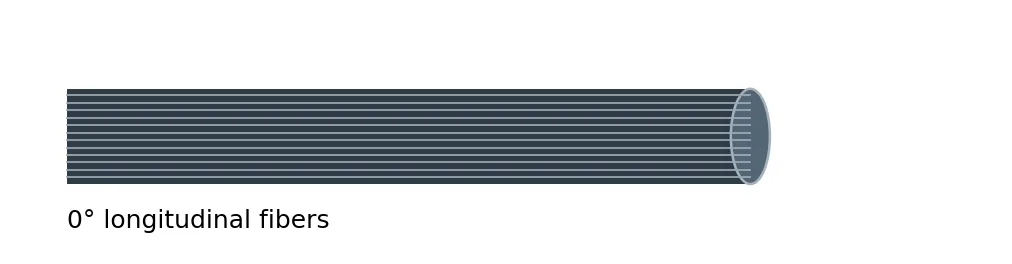 Conceptual illustration - not to scale.
Manufacturing process: Continuous carbon fiber tows are impregnated with resin, pulled through a forming die, and heated to cure into a rod with a constant cross section. Conventional structures consist primarily of longitudinal fibers oriented at 0°.
Advantages: High axial tensile strength and stiffness, good bending load capacity, efficient continuous production, consistent dimensions, suitability for standardized volume production, and relatively low cost.
Limitations: Transverse impact, localized concentrated loads, or torsional loads can cause matrix cracking, longitudinal splitting, and brittle fracture.
Typical applications: Structural reinforcement, industrial support rods, models, stiffeners, and structures carrying axial loads.
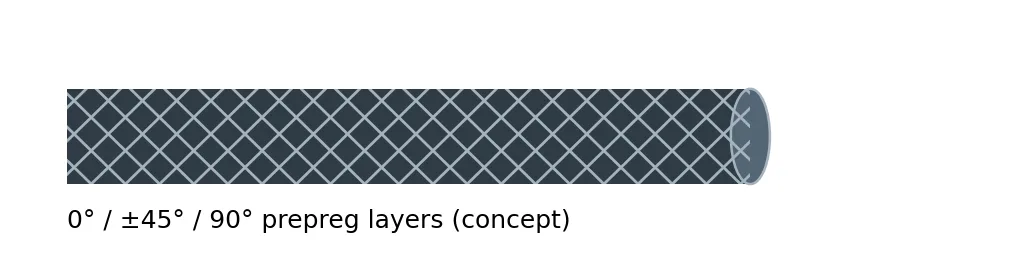 Conceptual illustration - not to scale.
Manufacturing process: Carbon fiber prepreg is cut, laid up at selected angles, wrapped, compressed, and cured. Fiber orientations can include 0°, ±45°, and 90°. Solid rods require special core materials or a dedicated forming method; hollow tube processes cannot simply be applied unchanged.
Advantages: Flexible layup design can balance bending, torsional, and transverse load performance. An appropriate layup can help limit splitting and the propagation of impact cracks.
Limitations: Manufacturing is more complex. Adding off-axis fibers may reduce axial stiffness or load capacity, so the proportions must be optimized.
Typical applications: Precision structural components, sporting goods, robotics, and components subjected to repeated bending.
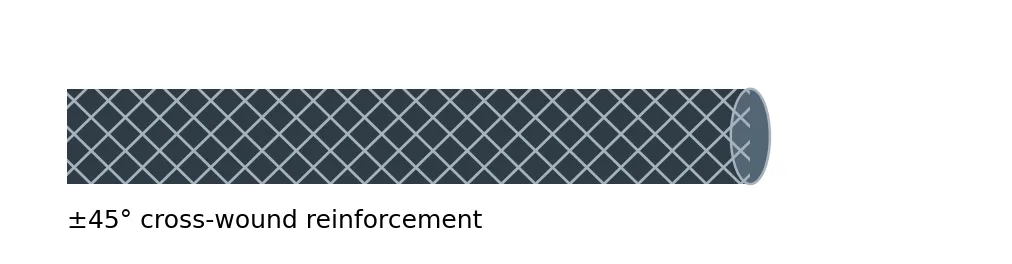 Conceptual illustration - not to scale.
Manufacturing process: Continuous fibers are wound onto a mandrel or core at designed angles, tension, and paths, then cured. Helical, cross, and hoop winding can be used. A solid rod can combine a longitudinal fiber core with an outer wound reinforcement.
Advantages: Controllable winding angles can improve hoop confinement, torsional resistance, and resistance to splitting, making the process suitable for customized structures. Limitations: Performance depends on fiber angle and content, winding tension, resin, and core material. Without sufficient longitudinal fibers, bending stiffness is not necessarily superior to that of a pultruded rod. Typical applications: Industrial shafts and structural components subjected to complex loads.
Comparison | Pultrusion | Roll wrapping | Filament winding |
Raw material | Continuous fiber tows | Prepreg | Continuous fiber tows |
Fiber orientation | Mainly 0° | Multi-angle layup | Multi-angle winding |
Axial tensile performance | High | Design dependent | Angle dependent |
Bending performance | High | Design dependent | Depends on longitudinal fiber proportion |
Impact damage resistance | Relatively limited | Can be enhanced | Can be enhanced |
Longitudinal splitting resistance | Relatively limited | Can be enhanced | Can be enhanced |
Torsion and multidirectional loads | Relatively limited | More flexible | More flexible |
Production efficiency | High | Medium | Structure dependent |
Manufacturing cost | Lower | Higher | Higher |
Product positioning | Standardized | Custom | Custom and hybrid structures |
Note: This is a qualitative comparison of typical structures and does not represent measured mechanical properties.
Possible factors include a structure consisting only of longitudinal fibers, insufficient resin toughness, poor fiber-resin bonding, localized stress concentrations, internal voids and manufacturing defects, unsuitable diameter or support span, and a lack of multidirectional reinforcing fibers. A higher fiber grade is not the only solution: fiber architecture, resin system, and manufacturing quality are also critical.
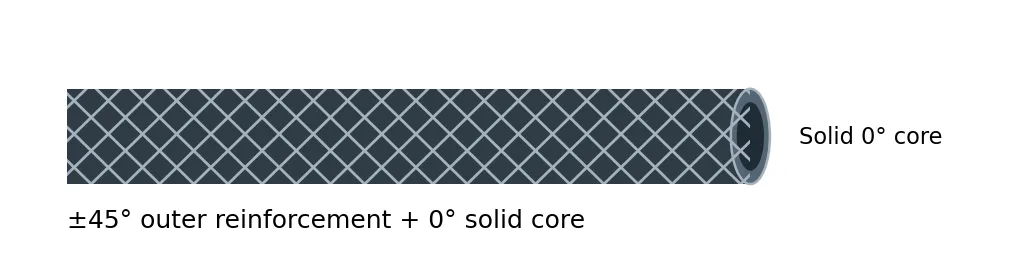 Conceptual illustration - not to scale.
One option to evaluate is a core of continuous longitudinal fibers at 0°, an outer cross reinforcement at ±45°, and a toughened epoxy resin system. The goal is to maintain bending load capacity while improving resistance to impact damage, splitting, and crack propagation. A hybrid structure does not outperform pultrusion in every property; actual performance must be verified by testing.
Application requirement | Processes to evaluate first |
High axial tension, conventional static bending, volume purchasing | Pultrusion |
Repeated bending | Multi-angle roll wrapping or hybrid structure |
Combined bending and impact loads | Hybrid structure |
Resistance to longitudinal splitting | Multi-angle roll wrapping or outer winding reinforcement |
Bending and torsion | Roll wrapping or winding reinforcement |
Complex loads and special performance requirements | Custom multi-angle or hybrid structure |
Before selection, define the diameter, length, support span, loads, impact conditions, frequency of use, temperature, tolerances, and expected service life. For high-performance products, verify bending, tensile, impact, and fatigue performance as well as failure modes.
GBTECH provides advanced composite materials and custom manufacturing solutions to customers worldwide. Options for evaluation include standard pultruded rods, multi-angle roll wrapped rods, winding-reinforced rods, and hybrid solid rods. Sample development and performance verification can take into account material grade, resin system, dimensions, tolerances, surface finish, and actual loading conditions.
No single manufacturing process is best for every carbon fiber rod application. Pultrusion offers advantages in standardization, longitudinal strength, and cost; roll wrapping provides flexible layup design; and filament winding offers additional possibilities for hoop reinforcement and hybrid structures. For combined bending and impact loads, a combination of continuous longitudinal fibers and multi-angle reinforcement is an option worth evaluating.
GBTECH U.S. Sales & Support
Website: www.gbtechmaterials.com
Email: zane@gbtechgroup.cn
Phone: +1 (510) 902-9987
California Warehouse: 38758 Buckboard Common, Fremont, CA 94536, United States
China Manufacturing Headquarters: Building 1, Left Side, Tangye Road, Xinxu, Huiyang, Huizhou, China
Selected standard products are stocked in California. Contact us to confirm availability, shipping origin and lead time for your specifications.


 WhatsApp
 E-mail