A frame may look like a simple part of an inspection machine. It holds the camera, supports the sensors and keeps the fixture in place. Once the equipment starts running, though, small movements in that frame can become difficult to ignore.
A crossbar bends slightly under a camera. A bracket needs realigning after removal. Readings change as the machine warms up.
A carbon fiber precision frame can be useful when equipment needs less weight without giving up the stiffness required for the job. Getting there starts with understanding what the frame carries, where movement matters and how it connects to the machine.
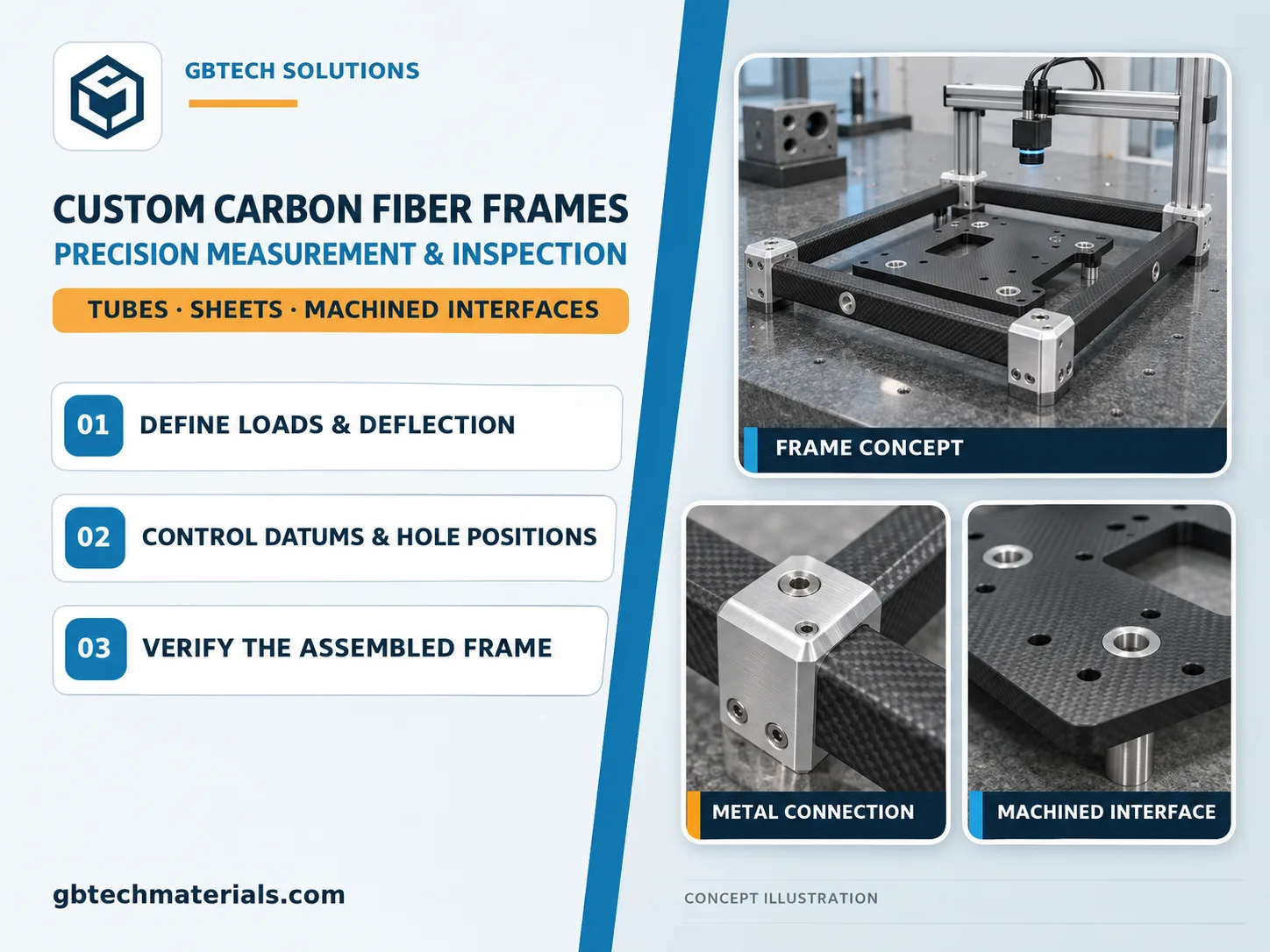
Take a vision inspection station with a camera above a workpiece fixture. The frame must fit inside the equipment, but its more important job is to keep the camera in the right position relative to the part.
How heavy is the camera? Will its cable pull on the bracket? Does the frame stay still, or move with a machine axis? These details help establish what the structure needs to do.
Mark the important mounting faces, locating holes and support points on the drawing. Explain where movement would affect the inspection result. This gives the manufacturing discussion a clear starting point and helps focus tighter tolerances on the features that need them.
Long crossbars and support members can often be made from carbon fiber tubes. Round and square tubes offer different connection options. Wall thickness and fiber arrangement also affect their behavior, so outside dimensions alone are not enough to choose a tube.
Camera bases, sensor brackets and fixture plates may suit parts machined from carbon fiber sheets. The outline, holes and mounting features can be made to fit the available space and the surrounding equipment.
Weight-saving cutouts need some thought. Removing material close to a camera mount may leave that area more flexible. Keep enough support around the points carrying the load, then review the complete part before releasing it for production.
Stiff frame members cannot keep a camera aligned if a corner joint moves. In a carbon fiber precision frame, the connections deserve as much attention as the tubes and plates.
Metal blocks, threaded inserts and locating bushings can help create practical assembly interfaces. Thin tube walls may need internal support or another way to spread the fastening load. Tightening a bolt harder is not a reliable answer to an unsuitable joint.
Bonded connections also need a defined process, including surface preparation, adhesive selection and assembly conditions. Where carbon fiber meets metal, the working environment should be considered when deciding whether isolation is needed.
For equipment that will be taken apart regularly, agree how the parts will locate when reassembled. Pins, shoulders or dedicated locating faces may help, depending on the design.
A 3D model shows the shape of a part. It may not explain which features control the position of the camera or sensor.
The drawing should distinguish fastening holes from locating holes and identify the faces that must sit against other components. Include the required dimensions and tolerances for those features.
This matters because parts can fit together while still leaving too much variation in the final assembly. A loose-fit bolt hole, for example, may be suitable for fastening but unsuitable for repeatable positioning.
Agree the manufacturing and assembly sequence too. Some parts can be finished separately, while certain interfaces may need checking after the frame is assembled. Settling this early helps avoid unnecessary adjustment later.
A frame measured on a bench may behave differently once installed. Its support points, fastening sequence and attached equipment all affect the final condition.
Check the sample using a mounting arrangement that represents the application. Fit the relevant camera, fixture or equivalent load, then inspect the positions that matter. If the equipment moves, include the expected motion conditions in the review.
Temperature and humidity may also need attention. Carbon fiber does not make the whole assembly immune to environmental changes, particularly when metal fittings are involved.
For a carbon fiber precision frame, the useful question is whether it holds the required positions during operation. Prototype checks should be planned around that requirement.
For custom carbon fiber structures, start with the assembly drawing, component models, equipment purpose, supported weight and expected quantities. Highlight the dimensions that affect inspection performance. Photos of an existing metal frame can also help explain the available space and the problems being addressed.
GBTECH can review how tube and sheet supply, precision carbon fiber machining and frame manufacturing could work together for the project. Including the existing structure and drawing requirements helps clarify the material choices, connections and machining scope before sample production and verification begin.
GBTECH U.S. Sales & Support
Website: www.gbtechmaterials.com
Email: zane@gbtechgroup.cn
Phone: +1 (510) 902-9987
California Warehouse: 38758 Buckboard Common, Fremont, CA 94536, United States
China Manufacturing Headquarters: Building 1, Left Side, Tangye Road, Xinxu, Huiyang, Huizhou, China
Selected standard products are stocked in California. Contact us to confirm availability, shipping origin and lead time for your specifications.


 WhatsApp
 E-mail