When selecting a carbon fiber tube, many engineers face a common question:
What should the outer diameter be? How is the inner diameter determined? Is thicker wall always better?
These dimensions are not just simple specification parameters—they directly affect the weight, stiffness, strength, and cost of the carbon fiber tube.
An excellent carbon fiber tube is not about having the largest dimensions, but about achieving the best balance between weight and structural performance while meeting requirements.
How to understand carbon fiber tube dimensional parameters?
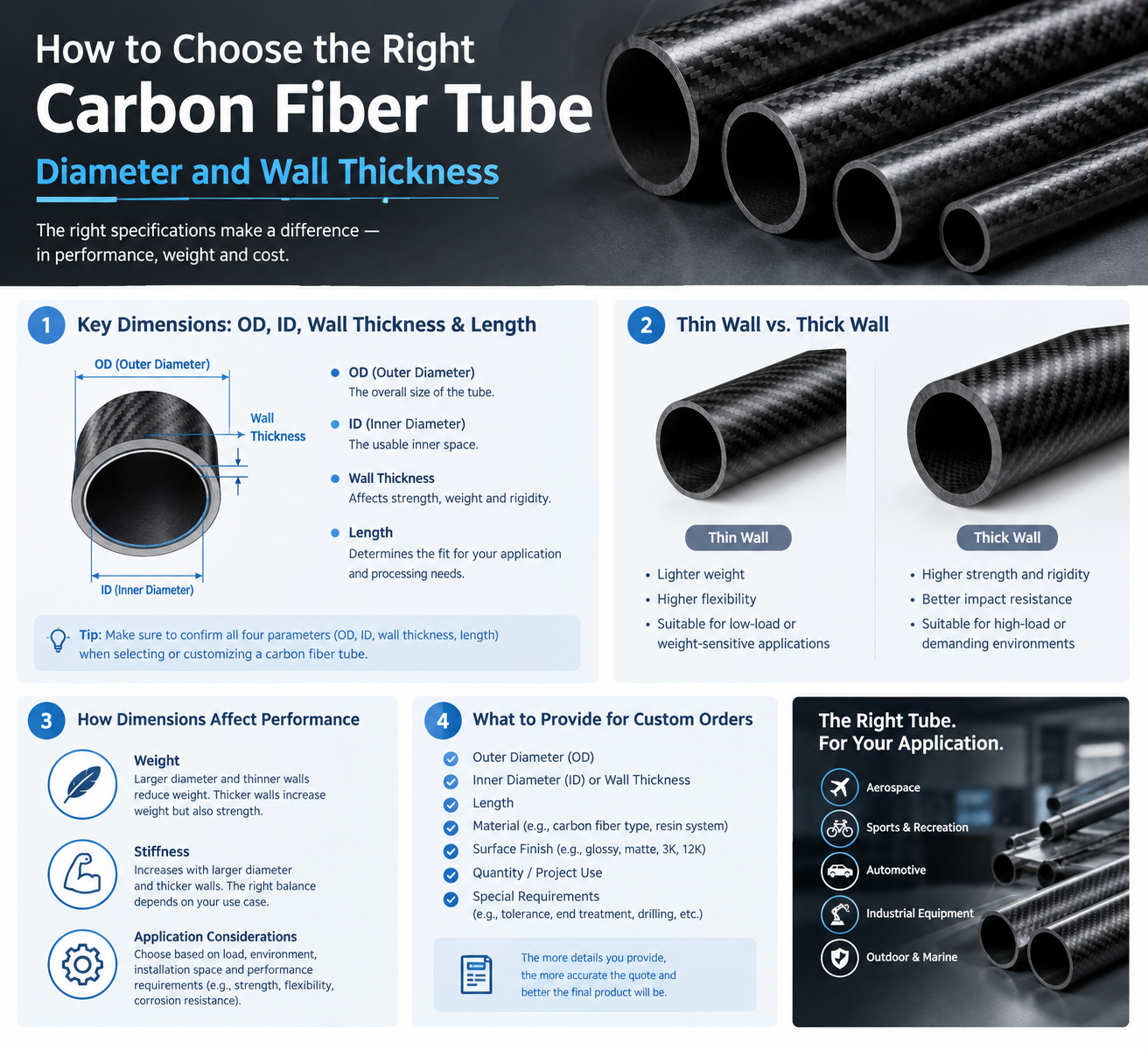
A carbon fiber tube is primarily defined by four parameters: outer diameter, inner diameter, wall thickness, and length.
Outer diameter determines the tube's overall size and how it mates with other components, and is often the first parameter to define in design. For example, in robotic structural parts, drone frames, or industrial equipment, the outer diameter typically needs to satisfy installation space and connection requirements.
Inner diameter affects the internal space of the tube, such as for routing cables, mounting shafts, or other components. Generally:
Inner Diameter = Outer Diameter - 2 × Wall Thickness
Therefore, the outer diameter, inner diameter, and wall thickness need to be determined together based on the actual application.
Length affects the tube's stability, machining precision, and shipping methods. For longer carbon fiber tubes, straightness and structural reliability also need to be considered.
How does wall thickness affect carbon fiber tube performance?
Wall thickness is a critical factor determining the performance of a carbon fiber tube.
Increasing wall thickness can improve the tube's stiffness, compressive strength, and impact resistance, making it suitable for industrial equipment, high-load structures, and applications requiring long-term stable operation.
However, increased wall thickness also brings higher weight and cost.
For lightweight applications such as drones, sports equipment, and portable devices, a thinner wall is often more advantageous. Therefore, the key to choosing wall thickness is not "thicker is better," but finding the optimal solution that meets your needs.
How to choose the right dimensions?
When selecting the diameter and wall thickness of a carbon fiber tube, you should first clarify the core requirements of your product.
lIf the application prioritizes weight (e.g., drones, portable structures, or sporting goods), prioritize a lightweight design.
lIf the application needs to withstand significant loads, or is subject to long-term vibration and impact, you need to increase structural stiffness—either by enlarging the tube diameter or optimizing wall thickness to improve reliability.
lIf the carbon fiber tube needs to fit existing interfaces, you typically need to determine the outer diameter first, then adjust the inner diameter and wall thickness based on performance requirements.
In many cases, reasonably increasing the tube diameter is more effective than simply increasing wall thickness, as it improves overall stiffness while better controlling weight.
What information is needed for custom carbon fiber tubes?
To obtain a more accurate material solution, the following information is typically required when ordering custom carbon fiber tubes:
lOuter diameter
lInner diameter or wall thickness requirements
lTube length
lMaterial grade
lSurface finish requirements
Additionally, providing information on the application scenario, load requirements, dimensional tolerances, operating environment, and order quantity will help the supplier perform more precise structural design and recommend the best solution.
Choose the right dimensions to unlock the advantages of carbon fiber tubes
The performance of a carbon fiber tube depends not only on the material itself—dimensional design is equally critical to the final outcome.
Choosing the right diameter, wall thickness, and length helps your product achieve better weight control and structural performance.
If you are looking for a carbon fiber tube solution for your project, feel free to provide your product dimensions and application requirements. The GBTECH engineering team will help you select the most suitable solution.
https://www.gbtechmaterials.com/SendInquiry/
https://www.gbtechmaterials.com/Carbon-Fiber-Tubes/
Official GBTECH Websites:
Email: zane@gbtechgroup.cn
Phone: +1 (510)902-9987
www.gbtechgroup.cn | www.gbtechcomposites.com | www.gbtechmaterials.com
US.Office: 38758 Buckboard Common, Fremont, CA 94536, United States
China Head Quaters: Building 1, Left Side, Tangye Road, Xinxu, Huiyang, Huizhou, China


 WhatsApp
 E-mail