A carbon fiber frame passes inspection at room temperature, yet its mounting points shift after the equipment warms up. For a measurement fixture, optical support or automation assembly, that movement can affect alignment even when the structure remains stiff.
Low carbon fiber thermal expansion makes composites attractive for precision equipment. The finished component, however, combines fibers, resin, different ply directions and often metal fittings. Each contributes to how the assembly changes shape as its environment changes.
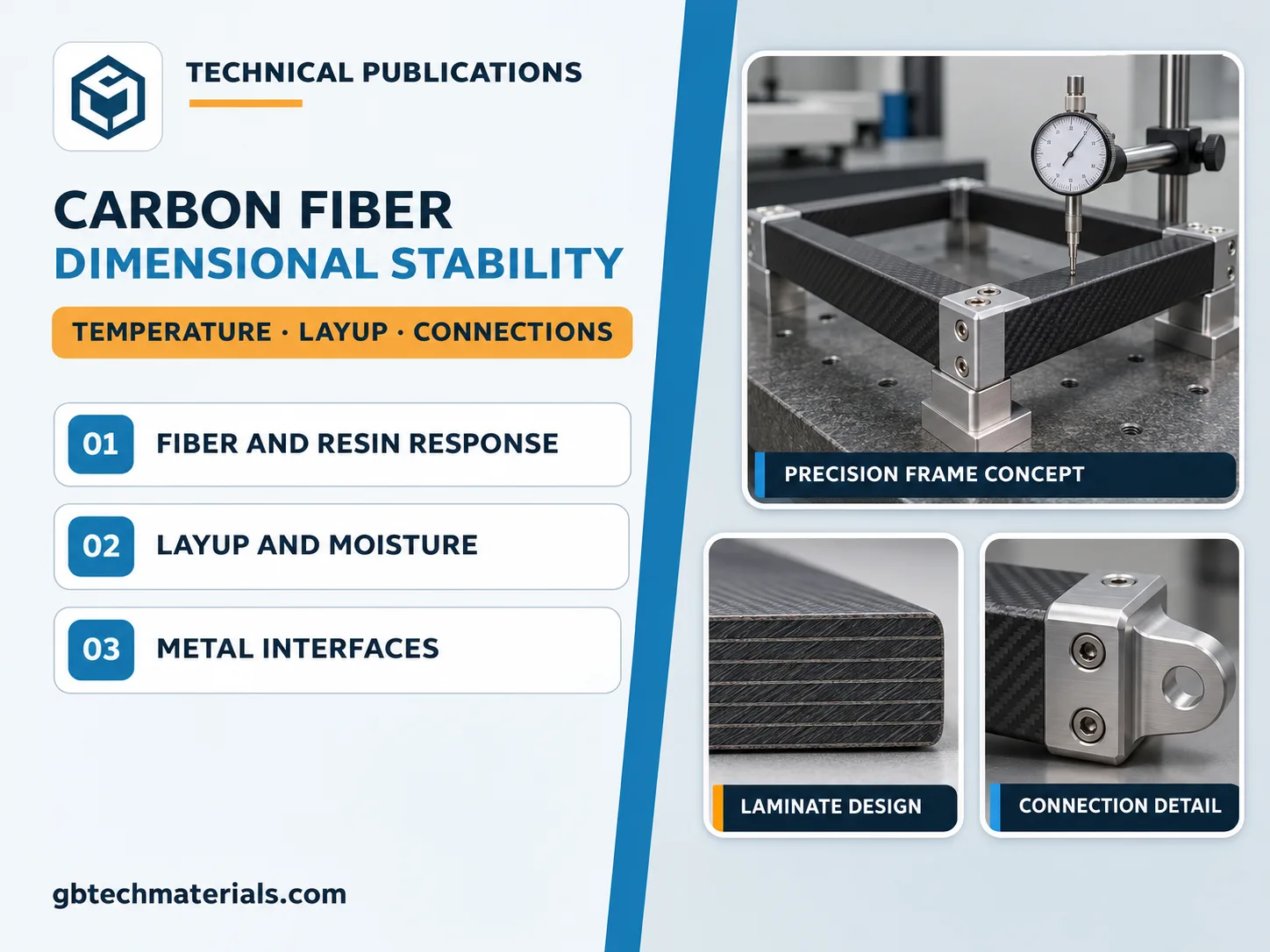
Carbon fibers generally have very low thermal expansion along their length. Some fibers can contract slightly over certain temperature ranges, while the surrounding polymer resin typically expands more.
The resulting composite therefore behaves differently in different directions. A carbon fiber tube with predominantly axial reinforcement may maintain its length well while its diameter and wall thickness respond differently. A value measured along the tube cannot describe every dimension of the part.
Start with the dimension that matters. Is it the distance between two mounting holes, the straightness of a beam or the position of a sensor? Its relationship to the fiber directions should guide material selection and the interpretation of thermal data.
Plies at different angles have different expansion responses. When those plies are distributed unevenly through the thickness, temperature changes can produce curvature as well as changes in length.
A laminate designed symmetrically about its midplane helps reduce bending caused by uniform temperature changes. Balanced plies address particular extension–shear coupling effects. Both deserve attention, although neither alone guarantees a stable finished structure.
Machining can also change the picture. A precision bracket cut from carbon fiber sheet may include pockets, steps or locally thinned sections. Those features can alter the local laminate arrangement and stiffness. Review the finished geometry alongside the original layup, especially where flatness or mounting alignment is critical.
CFRP dimensional stability also depends on moisture. The resin can absorb water from the surrounding environment and swell, then release moisture when conditions become drier.
This response can complicate measurements taken on different days or after storage and transport. Uneven exposure can matter too, particularly when one surface has a different coating or faces a different environment.
Record temperature, relative humidity and conditioning time when checking sensitive dimensions. A component moved directly from a warehouse into a controlled inspection room may need time to stabilize before its measurements are compared with the drawing. The conditioning procedure should be agreed for the material and application.
A composite beam may change little in length while its aluminum end fittings move enough to affect the assembly.
Differences in expansion between the composite, metal and adhesive can create joint stresses or shift mounting positions. Fitting length, adhesive thickness, bolt placement and the freedom to accommodate movement all influence the result.
For this reason, carbon fiber thermal expansion should be assessed alongside the connection design. Testing a bare tube provides useful material information, but an assembled frame introduces additional interfaces and constraints. Where alignment matters, evaluate the structure with representative fittings and mounting conditions.
Precision composite structures need a manufacturing plan that reflects their dimensional requirements. Cure conditions, cooling and material removal can influence residual stresses and the shape measured after the part leaves its tooling.
During machining, excessive clamping force can hold a flexible component in position temporarily. Once released, it may spring back. For sensitive parts, releasing the fixture and checking dimensions between suitable operations can help reveal movement before final inspection.
Inspection should also separate room-temperature acceptance from operating performance. A drawing may require a hole spacing at the inspection temperature, while the equipment needs that spacing to remain within a defined range during use. These are separate requirements and should be documented clearly.
A single expansion coefficient is useful for an initial estimate. It cannot describe every effect of temperature gradients, moisture, joints and installation constraints.
For critical assemblies, an agreed verification plan may include measurements at selected temperatures or after thermal cycling. Check the features that determine equipment performance, such as mounting-point spacing, straightness, flatness or angular alignment. Define the allowable movement and measurement method before testing.
Carbon fiber temperature stability is most useful when expressed as a requirement for the finished assembly under specified conditions. Local heat sources also deserve attention because one side of a structure may warm faster than the other.
When reviewing carbon fiber thermal expansion for a new component, provide the operating temperature range, expected temperature changes, humidity conditions, critical tolerances and connection details.
For a GBTECH manufacturing review, include those conditions with the component drawings and assembly interfaces. They give the discussion a practical starting point for material, layup and machining decisions. Final suitability should be confirmed through verification of the relevant structure under its intended operating conditions.
GBTECH U.S. Sales & Support
Website: www.gbtechmaterials.com
Email: zane@gbtechgroup.cn
Phone: +1 (510) 902-9987
California Warehouse: 38758 Buckboard Common, Fremont, CA 94536, United States
China Manufacturing Headquarters: Building 1, Left Side, Tangye Road, Xinxu, Huiyang, Huizhou, China
Selected standard products are stocked in California. Contact us to confirm availability, shipping origin and lead time for your specifications.


 WhatsApp
 E-mail